Bal-tec™ Home Truncated Balls, Balls with a Flat
Truncated Balls — Balls with a Flat — Flatted Balls — Hemispheres
We now stock a broad line of type 440c Hard stainless steel partial spheres and a large array of over run in many sizes and materials Truncated balls are the most popular form of modified balls. They usually consist of balls with a flat ground on them, but sometimes Electrical Discharge Machines or conventional chip making machines are used. The ground flat on hardened steel balls of chrome steel or of type 440c stainless steel will typically have an 8 microinch (0.0002032mm) Ra surface finish and will be flat within one ten thousandths of an inch (0.00254mm).
Balls with a flat can be supplied in any material, including chrome steel, type 440c hard stainless steel, soft 300 series stainless steels, tungsten carbide or ceramic. In critical situations, the flat ground surface, of the truncated balls can be precision flat lapped, after grinding, to produce a surface, that is flat within light bands or even fractions of a light band. By flat lapping, the surface texture, can be controlled down to less than one micro inch (25 nanometers) when required. Commercial tolerance on the overall height of the truncated balls is usually plus or minus, three thousandths of an inch (0.00762mm).
Closer tolerance can be held by exercising extra care. The closest size tolerance that can be held absolutely, is about twenty millionths of an inch (0.5 micrometer). Factors that limit this tolerance is, the original quality of the ball, the ability to determine the absolute diameter of the ball, and the distance from the flat to the top of the ball. These problems are mainly uncertainties in the corrections, for hertzine elastic deformation, (See our technical paper “How balls are made and how they are measured”). Balls with a flat ground or machined on them are widely used in industry. Flat areas can be ground, EDM'ed, or machined on balls.
We developed production holding devices that allow us to machine a flat surface on a precision ball without adversely effecting quality. For even higher quality requirements, a preliminary flatting process can be performed, then the balls is precision flat-lapped to hold a very close dimensional tolerance and micro-inch surface quality. Precision balls can also be ground and/or lapped for parallel flats. (See Ball Gages)
Clamping
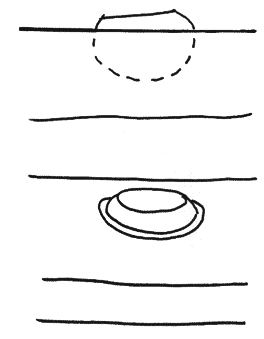
One common application is for use as a self-aligning flat for clamping (see figure #2).
Mounting
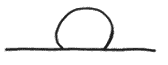
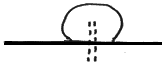
A flat provides a positive plane for mounting the ball in mechanical systems. Many times the truncated ball is further modified to include a hole, or a threaded hole. In the kinematic arena, truncating balls are a widely used method of mounting spherical contacts (see figure #3A, #3B, and #3C).
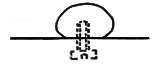
Machine Tools
In machine tool calibration, or for machine set-up, almost perfect hemispheres are used to exactly define the multi-axis true position of all of the related elements. By locating the perfect hemisphere on the rotational axis of the machine and knowing it's exact radius, the interrelated axii of all other elements can be accurately determined.
Staking
Another version of the truncated ball is a ball with two parallel flats. These very precise spherical disks are widely used to stake together extremely precise mechanical or electromechanical assemblies. These precise spherical disks are also used as self-aligning thrust plates in small electro-mechanical mechanisms. In some elaborate systems the two flat faces are precision lapped both flat and exactly parallel (see figure #4).
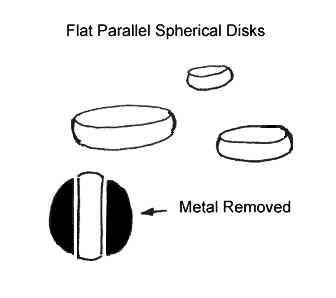
The amount of truncation varies according to the application. It may be a small, highly-polished spot called a facet, or there may only be a sliver of the ball remaining, used as a wear or location pad. One of our European customers needed exact hemispheres, but he believed that they couldn't be produced because there was nothing left to hold them during the stock removal. We actually have a choice of several holding and machining methods that can be used for this chore, depending on the end application, the quality, and the number of parts involved. The ball can be held for modification by clamping in a collet or pot-chuck. It can be held in a diffusion chuck or mounted in a vacuum holding device. The ball can be machined in a turning center (lathe). It can be surface ground on a reciprocating table or on a rotating table type machine.
Silicon Lens
We make extremely high quality silicon balls with a precisely truncated flat surface that is polished to optical lens quality for use in the infrared communication field.
Formed Truncation
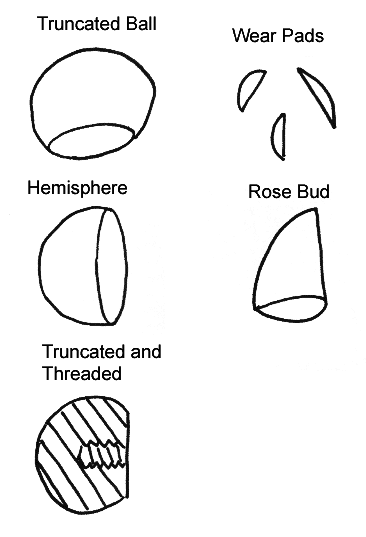
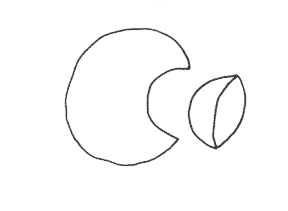
Another form of truncation, in a sense, is when a form is cut out of a complete ball. (See Figure #5.)
See truncated balls in our kinematic catalog #105-B for off-the-shelf truncated balls.
Hemispheres
We now stock a broad line of type 440c Hard stainless steel partial spheres and a large array of over run in many sizes and materials Truncated balls are the most popular form of modified balls. They usually consist of balls with a flat ground on them, but sometimes Electrical Discharge Machines or conventional chip making machines are used.
The ground flat on hardened steel balls of chrome steel or of type 440c stainless steel will typically have an 8 microinch (0.0002032mm) Ra surface finish and will be flat within one ten thousandths of an inch (0.00254mm). Balls with a flat can be supplied in any material, including chrome steel, type 440c hard stainless steel, soft 300 series stainless steels, tungsten carbide or ceramic.
In critical situations, the flat ground surface, of the truncated balls can be precision flat lapped, after grinding, to produce a surface, that is flat within light bands or even fractions of a light band. By flat lapping, the surface texture, can be controlled down to less than one micro-inch (25 nanometers) when required.
Commercial tolerance on the overall height of the truncated balls is usually plus or minus, three thousandths of an inch (0.00762mm). Closer tolerance can be held by exercising extra care. The closest size tolerance that can be held absolutely, is about twenty millionths of an inch (0.5 micrometer). Factors that limit this tolerance is, the original quality of the ball, the ability to determine the absolute diameter of the ball, and the distance from the flat to the top of the ball. These problems are mainly uncertainties in the corrections, for hertzine elastic deformation, (See our technical paper "How balls are made and how they are measured").