Bal-tec™ Home Bearing Steel for Steel Balls
Bearing Steel for Steel Balls
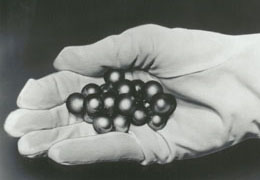
C/S - Chrome Steel, 52100, Chrome
All of the above are common ways of describing the most widely used material for the manufacture of precision steel balls. It is a through hardening, fine grain, Martensitic steel. Because of its high hardness and fine grain structure, this material can be finished to an extremely fine quality. This material is commonly used for gauge ( gage ) balls. Check out our available stock in our shopping cart.
- Hardness
- Using our standard heat treating procedure, this material will harden to a minimum of 60 on the Rockwell "C" scale (60 HRC). The hardness may be measured between parallel ground flats. If the reading is taken on a spherical surface, it is corrected for the curve. The HRC scale uses 150 Kilogram Load ( approximately 330 lb. ) applied to a conical diamond brale indenter. This material is commonly used for gauge ( gage ) balls. This material is considered a Ferrous Metal.
- Density
- The density of this material, chrome steel, is .283 pounds per cubic inch ( 7.85 g/ cm³ ).
- Magnetic
- This material is strongly attracted by a magnetic field.
- Machinability
- In the hardened condition, this material can be ground, honed, and lapped using conventional abrasives. It can be shaped and drilled using electrical discharge machining or ultrasonic cavitation. In the annealed condition, this material can be machined using normal techniques.
- Weldability
- Because this material has 1% carbon, it does not weld well. It can be resistance welded with difficulty. It can be soft soldered with a high tin solder using an acid flux. It can be silver soldered or brazed; but the heat will cause distortion of the ball and a loss of hardness. For light load applications, the ball can be attached with an adhesive such as epoxy. When adhesive bounding is used, an area on the ball should be roughed up by etching or abrasive blasting. The area should be thoroughly cleaned.
Chrome steel balls will rust if they are in contact with water. Consider using stainless steel balls or brass balls in a wet environment.
All of the above are common ways of describing the most widely used material for the manufacturer of precision steel balls. It is a through hardening, fine grain, Martensitic steel. Because of its high hardness and fine grain structure, this material can be finished to an extremely fine quality.
| Chrome Steel Chemical Analysis | |
|---|---|
| Carbon | 0.95 - 1.10% |
| Manganese | 0.2 - 0.45% |
| Silicon | 0.25 - 0.35% |
| Phosphorus | 0.025% Max. |
| Sulfur | 0.025% Max. |
| Chromium | 1.30 - 1.60% |
| Ferrite | Balance |
Chrome Steel Ball Crush Strength Data
*Calculated on .283 pounds per cubic inch density.
| Size - Inches | Balls per pound | Weight per ball | Crush strength in pounds | Size - Inches |
|---|---|---|---|---|
| 1/32 | 221138. | --- | --- | 1/32 |
| 1/16 | 27642.3 | --- | 270 | 1/16 |
| 3/32 | 8190.32 | --- | 610 | 3/32 |
| 1/8 | 3455.29 | .131 gr. | 1100 | 1/8 |
| 5/32 | 1769.11 | .256 gr. | 1710 | 5/32 |
| 3/16 | 1023.79 | .443 gr. | 2470 | 3/16 |
| 7/32 | 644.719 | .703 gr. | 3360 | 7/32 |
| 1/4 | 431.911 | 1.050 gr. | 4400 | 1/4 |
| 9/32 | 303.345 | 1.495 | 5560 | 9/32 |
| 5/16 | 221.138 | 2.051.gr. | 6870 | 5/16 |
| 11/32 | 166.144 | 2.730 gr. | 8300 | 11/32 |
| 3/8 | 127.973 | 3.544 gr. | 9900 | 3/8 |
| 13/32 | 100.654 | 4.506 gr. | 11600 | 13/32 |
| 7/16 | 80.5899 | 5.628 gr. | 13400 | 7/16 |
| 15/32 | 65.5225 | 6.923 gr. | 15400 | 15/32 |
| 1/2 | 53.9889 | 8.402 gr. | 17600 | 1/2 |
| 17/32 | 45.05 | 10.077 gr. | 18000 | 17/32 |
| 9/16 | 37.9181 | 11.96 gr. | 20200 | 9/16 |
| 19/32 | 32.26 | 14.069 gr. | 22500 | 19/32 |
| 5/8 | 27.6423 | 16.41 gr | 25000 | 5/8 |
| 21/32 | 23.86 | 19.996 gr. | 27560 | 21/32 |
| 11/16 | 20.7681 | 21.841 gr. | 30200 | 11/16 |
| 23/32 | 18.18 | 24.957 gr. | 33000 | 23/32 |
| 3/4 | 15.9967 | 1.00 oz. | 36000 | 3/4 |
| 25/32 | 14.15 | 1.13 oz. | 39000 | 25/32 |
| 13/16 | 12.5818 | 1.26 oz. | 42200 | 13/16 |
| 27/32 | 11.24 | 1.42 oz. | 45500 | 27/32 |
| 7/8 | 10.0737 | 1.58 oz. | 49000 | 7/8 |
| 29/32 | 9.06 | 1.76 oz. | 52500 | 29/32 |
| 15/16 | 8.19032 | 1.95 oz. | 56200 | 15/16 |
| 31/32 | 7.42 | 2.16 oz. | 60000 | 31/32 |
| 1 | 6.74861 | 2.36 oz. | 64000 | 1 |
| 1-1/16 | 5.63 | 2.84 oz. | 72200 | 1-1/16 |
| 1-1/8 | 4.73977 | 3.375 | 81000 | 1-1/8 |
| 1-3/16 | 4.03 | 3.970 oz. | 90200 | 1-3/16 |
| 1-1/4 | 3.45529 | 4.631 oz. | 100000 | 1-1/4 |
| 1-5/16 | 2.99 | 5.360 oz. | 104700 | 1-5/16 |
| 1-3/8 | 2.59601 | 6.163 oz. | 108900 | 1-3/8 |
| 1-7/16 | 2.27 | 7.043 oz. | 115700 | 1-7/16 |
| 1-1/2 | 1.99959 | 8.002 oz. | 122400 | 1-1/2 |
| 1-5/8 | 1.57273 | 10.173 oz. | --- | 1-5/8 |
| 1-3/4 | 1.25921 | 12.706 oz. | --- | 1-3/4 |
| 1-7/8 | 1.02379 | 15.628 oz. | --- | 1-7/8 |
| 2 | .843577 | 1.00 lb. & 2.967 oz. | --- | 2 |
| 2-1/8 | .703296 | 1.00 lb. & 6.750 | --- | 2-1/8 |
| 2-1/4 | .592471 | 1.00 lb. &11.006 oz | --- | 2-1/4 |
| 2-3/8 | .503760 | 1.00 lb. & 15.761 oz. | --- | 2-3/8 |
| 2-1/2 | .431911 | 2.00 lbs. & 5.045 oz. | --- | 2-1/2 |
| 2-5/8 | .373101 | 2.00 lbs.&10.884 oz. | -- | 2-5/8 |
| 2-3/4 | .324501 | 3.00 lbs. & 1.306 oz. | -- | 2-3/4 |
| 2-7/8 | .283988 | 3.00 lbs. & 8.340 oz. | -- | 2-7/8 |
| 3 | .249948 | 4.00 lbs & 0.013 oz. | -- | 3 |
| 3-1/8 | .221138 | 4.00 lbs & 8.353 oz. | -- | 3-1/8 |
| 3-1/4 | .196591 | 4.00 lbs & 1.387 oz. | -- | 3-1/4 |
| 3-3/8 | .175547 | 5.00 lbs & 11.144 oz | -- | 3-3/8 |
| 3-1/2 | .157402 | 6.00 lbs. & 5.650 oz. | -- | 3-1/2 |
| 3-5/8 | .141674 | 7.00 lbs. & 0.935 oz. | -- | 3-5/8 |
| 3-3/4 | .127973 | 7.00 lbs. & 13.026 oz. | -- | 3-5/8 |
| 3-7/8 | .115984 | 8.00 lbs. & 9.950 oz. | -- | 3-7/8 |
| 4 | .105447 | 9.00 lbs. & 7.735 oz. | -- | 4 |
| 4-1/8 | .096148 | 10.00 lbs. & 6.409 oz. | -- | 4-1/8 |
| 4-1/4 | .087911 | 11.00 lbs & 6.000 oz. | -- | 4-1/4 |
| 4-3/8 | .080589 | 12.00 lbs & 6.536 oz. | -- | 4-3/8 |
| 4-1/2 | .074058 | 13.00 lbs. & 8.044 oz. | -- | 4-1/2 |
See the page, Ball Material Selection for more information.
